On this page
- Quick takeaways
- Do vision boards actually work?
- How do you make a vision board, step by step?
- Vision board ideas for health and body
- Vision board ideas for work and career
- Vision board ideas for money
- Vision board ideas for home
- Vision board ideas for relationships and family
- Vision board ideas for creativity and learning
- Vision board ideas for travel and adventure
- Vision board ideas for rest and self-care
- Vision board ideas for community and giving back
- What kind of vision board should you make?
- What should you not put on a vision board?
- Vision board questions people ask
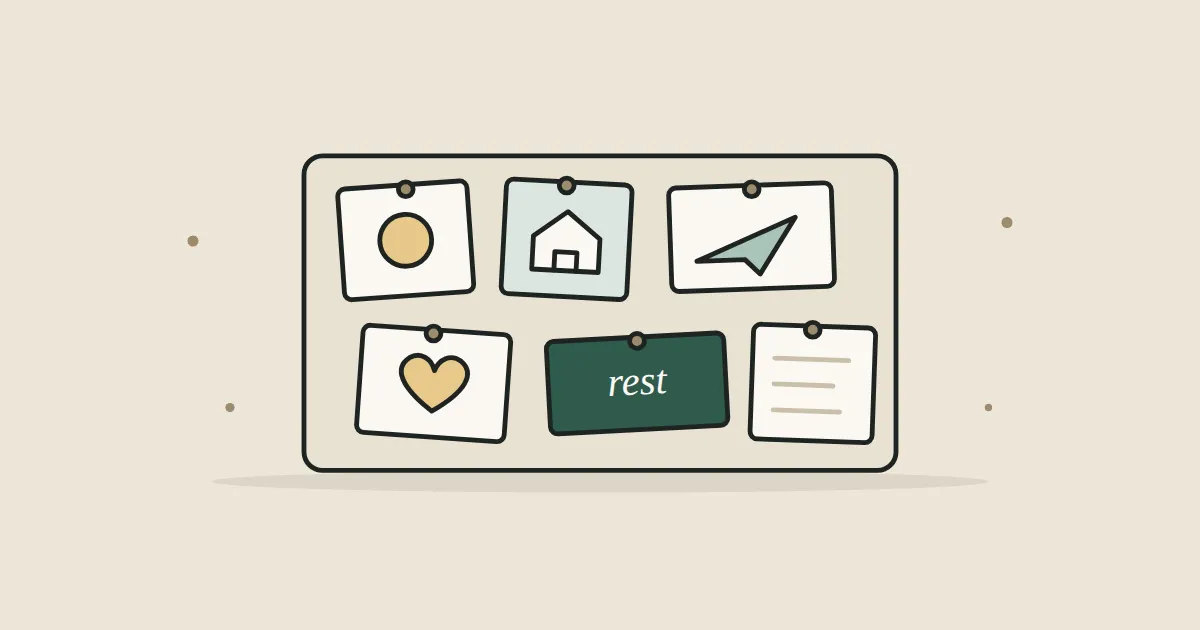
A vision board is a page or a board of pictures and words that stand for what you want your life to look like. The usual version is a stack of magazines, scissors and glue on one evening in January.
The pictures are the easy part. A board becomes useful when it also says what’s likely to get in the way, and what you’ll do when it does.
Good vision board ideas are specific and ordinary: a picture of the room you want to wake up in, the view from a walk you want to take weekly, a word like “rested” or “finish.” Pick three to six areas of life, choose one image and one word for each, then write down the obstacle you expect and an if-then plan to get past it.
Plan your vision board
Pick up to six parts of your life. We’ll give you what to picture and what to plan for.
Areas of life (3 of 6)
What kind of board?
Pin one card per area and leave space around each so you can swap images later.
The printout has a box for each area with its word, its obstacle and a line for your if-then plan. Nothing here is stored or sent.
Quick takeaways
- 40 vision board ideas below, sorted into ten areas of life. Pick three to six areas, not all ten.
- Choose specific pictures you can act on: a photo of your actual running route rather than a stock photo of a marathon.
- In lab studies, imagining the ideal future on its own left people with less energy to act on it. Pairing the picture with the obstacle helped.
- Add an if-then plan under each image: “If I’m too tired after work, then I’ll run on Saturday morning instead.”
- Put the board where you’ll see it every day. A notebook spread or phone wallpaper counts.
Do vision boards actually work?
A vision board works when it reminds you to act, not when it only makes you feel good about the future. In a 2011 set of four experiments, people who imagined an idealized future had less energy afterward than people who imagined a more realistic one, and that lower energy went with lower achievement. Adding the obstacle and a plan is what turns the board into a tool.
The experiments, by Heather Barry Kappes and Gabriele Oettingen, are published as “Positive fantasies about idealized futures sap energy” in the Journal of Experimental Social Psychology. They measured energy through physiological and behavioral measures, and found the effect was strongest when the fantasy was about something people needed urgently.
A four-step method built on Oettingen’s research is called WOOP: Wish, Outcome, Obstacle, Plan. You name the wish, picture the best outcome, then picture the main obstacle inside you, and make a plan in the form “If (obstacle), then I will (action)”. A 2021 meta-analysis of 21 studies and 15,907 participants found this approach, called mental contrasting with implementation intentions, helped people reach their goals with a small to medium effect (g = 0.336).
A vision board already covers the first two steps. The planner above adds the other two.
How do you make a vision board, step by step?
Choose three to six areas of life, find one specific image and one word for each, arrange them on a board, page or screen, then write the obstacle and an if-then plan under each image. Put it somewhere you’ll see daily and review it once a month.
- Pick your areas. Three to six. A board with ten goals on it is a collage, not a plan.
- Picture an ordinary day, not a highlight. Ask what a normal Tuesday looks like when this part of life is going well. That’s the image you’re looking for.
- Find or make the image. Your own photos, magazine cut-outs, printouts or a quick sketch all work. Specific beats glossy.
- Add one word per area. Words like “rested,” “finish” or “buffer” keep the board readable at a glance.
- Write the obstacle. What inside you usually stops this? Tiredness, avoidance, saying yes to everything.
- Write the if-then plan. “If I’m scrolling at 10pm, then I’ll put the phone on the kitchen counter.”
- Put it where you’ll see it. Above the desk, inside the front of your journal or as your lock screen.
- Review it monthly. Swap images that no longer fit and rewrite plans that didn’t work.
If a goal needs daily tracking, pair the board with a printable habit tracker so the plan has somewhere to be checked off.
Vision board ideas for health and body
Health vision board ideas work best as scenes from a normal day: your walking route, a packed lunch, a bedtime you keep, your shoes by the door. Pick pictures of habits, not results.
- A photo of your walking or running route, taken on a good morning.
- Your ideal bedtime written large, with a picture of your bedside table without a phone on it.
- A lunch you’d like to be eating most weekdays.
- The shoes, bike or mat you want to use three times a week.
Vision board ideas for work and career
Work vision board ideas show the work itself: the desk you want, the project you want to finish, the skill you want to be known for. Titles and salaries make weaker pictures than the day-to-day work you want to be doing.
- A picture of the finished project: the book cover, the launched site, the shop sign.
- The desk or workspace you want, cleared of what distracts you.
- One word for how you want to work: “focus,” “craft,” “calm.”
- The time you want to finish work each day, written as a clock.
Vision board ideas for money
Money vision board ideas should show what the money is for, not piles of cash: an emergency fund with a number and a date, a debt with a line through it, or the thing you’re saving toward.
- A savings bar you color in as you go, with the target written at the top.
- The item or trip you’re saving for, with its price and a date.
- A crossed-out debt balance to fill in the day it’s paid.
- The word “enough,” for a month with money left over.
Vision board ideas for home
Home vision board ideas are pictures of one room done the way you want it, a plant that’s still alive, or the table set for people you want to have over.
- One room exactly as you want it. Just one.
- A clear kitchen table on a Sunday morning.
- A plant you’d like to keep alive for a year.
- Your front door with a wreath or a new color.
Vision board ideas for relationships and family
Relationship vision board ideas show time with people: a regular dinner, a trip with a friend, a phone call you want to make weekly. Use photos of the actual people if you have them.
- A photo of the people you want around your table more often.
- A date night or friend night written on a calendar page.
- A card for a letter you want to send or a call you want to make.
- The word “honest,” “close” or “together.”
Vision board ideas for creativity and learning
Creative and learning vision board ideas show the finished thing and the practice: a sketchbook filled, a song recorded, a language lesson streak, a class you want to take.
- The thing you want to make, finished and in someone’s hands.
- A sketchbook, guitar or sewing machine you want to use weekly.
- A sentence in the language you’re learning.
- The class or course you want to sign up for, with its start date.
- A stack of books you want to read this year.
- The word “finish,” for a project that’s been waiting.
Vision board ideas for travel and adventure
Travel vision board ideas are specific places, not generic beaches: the town you want to visit, the trail you want to walk, the train you want to take, with a rough month next to each.
- One specific place you want to wake up in, with a month written beside it.
- A trail, hill or coastline near you that you’ve never walked.
- A map with a circle around a day trip you can take this season.
- A ticket, real or drawn, for a trip you want to book.
Vision board ideas for rest and self-care
Rest vision board ideas show what an unhurried day looks like to you: an empty afternoon, a bath, a book, a phone in another room.
- An afternoon with nothing on the calendar, drawn as a blank page.
- A book on a chair with a cup of tea next to it.
- Your phone in a drawer at a set time each evening.
- The word “rest,” “slow” or “off.”
Vision board ideas for community and giving back
Community vision board ideas show where you want to belong and what you want to give: a club, a volunteer shift, a local event, a neighbor you want to know by name.
- The club, choir or team you want to join.
- A volunteer shift you want to do monthly.
- A local event you want to go to this year.
- The café or library where you want to be a regular.
- A name you want to know: the neighbor you only wave to.
- The word “belong.”
What kind of vision board should you make?
Make the kind of board you’ll see every day. A cork board suits a desk, a journal spread suits people who open their notebook daily, a phone wallpaper suits people who don’t, and a word board suits anyone who dislikes collage.
- Cork board or poster. Easy to change. Leave space around each image so you can add the if-then plan.
- Journal spread. Pictures on the left page, obstacles and plans on the right. If you keep a bullet journal, it can sit next to your yearly goals page.
- Phone wallpaper. Three areas at most, or it won’t be readable on a lock screen.
- Word board. One large word per area and the plan written small underneath. Good for people who don’t want to hunt for images.
For the how-to of the notebook system itself, see how to bullet journal.
What should you not put on a vision board?
Leave off anything you can’t picture as an ordinary day, anything that’s someone else’s goal for you and anything you only want because it looks good. A board full of stock photos of luxury gives you nothing to plan for.
- Other people’s bodies or lives, pinned as a target.
- Big results with no step you control, like “get famous.”
- More than six areas at once.
- Anything you’d be embarrassed to explain to yourself in a year.
If you want a deeper look at what you want from the next few years before you start, the best possible self exercise is a ten-minute writing version of the same idea.
If you’d rather start the year in words than pictures, the new year journal prompts cover intentions, a word of the year and goals.
Vision board questions people ask
When is the best time to make a vision board?
Any time you want to change direction. January is popular, but a birthday, a new job or the start of a season works as well. Review it monthly whenever you make it.
How many pictures should a vision board have?
One or two per area of life, for three to six areas. That’s roughly six to twelve images, which is enough to fill a board without losing track of what each one stands for.
Can you make a vision board in a journal?
Yes. A two-page spread works well: images on one side and the obstacle and plan for each on the other. Some people add a smaller version at the start of each month.
Where should you put your vision board?
Somewhere you look every day without trying: above a desk, on the inside of a closet door, at the front of your journal or on your phone’s lock screen.
What is the difference between a vision board and a goal list?
A vision board uses images to hold the picture of the outcome in mind. A goal list is written. The strongest version of either names the obstacle and the plan as well as the goal.
Otis Fenn
Otis covers planning methods, notebooks, pens and apps, so you don't buy three of each. Otis is a pen name Mike writes under. About our writers