



On this page
- Quick takeaways
- What is a creative writing prompt?
- Character prompts for short stories
- Setting prompts: where could your story happen?
- Object prompts: what’s in the room?
- Plot twist and complication prompts
- What are good first lines to start a story?
- Short story prompts you can finish in ten minutes
- How do you turn a prompt into a finished short story?
- Creative writing questions people ask
Start here
Creative writing prompts for adults: 100 short story starters
Sorted by what you need: a person, a place, a thing, a twist, or just a first line.
Most writing prompt lists are one long scroll: a hundred ideas in no particular order, some about dragons, some about your childhood bedroom. Useful if you know what you’re looking for. Less useful at 9pm, when all you know is that you want to write something.
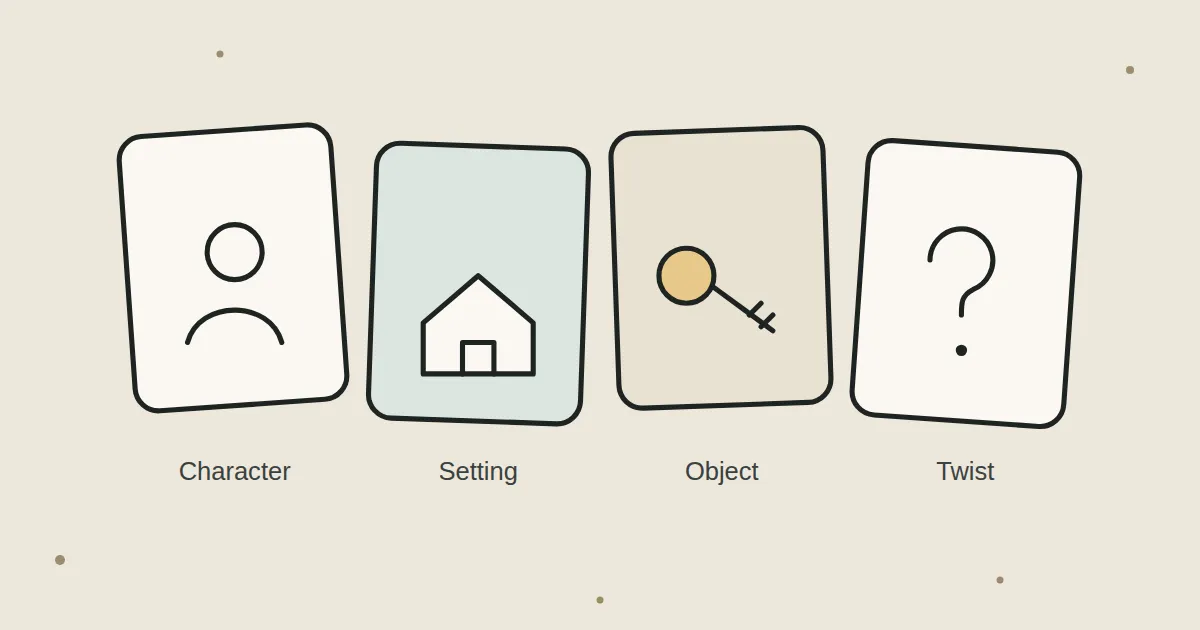
These creative writing prompts for adults are sorted by what they hand you: a character, a setting, an object, a twist, a first line or a story you can finish in ten minutes. Pick the kind of push you need, or spin the story spark below for a random combination, then write for twenty minutes without stopping.
Spin a story spark
Lock the cards you like and spin the rest. Nothing here is stored or sent.
Quick takeaways
- 100 short story prompts in six groups: characters, settings, objects, twists, first lines and ten-minute stories.
- Combine one from each of the first four groups and you’ve got a whole story premise.
- The story spark above does the combining for you. Lock the cards you like and spin the rest.
- Write for twenty minutes before judging anything. First drafts are allowed to be bad.
- Every prompt is written for adults: work, grief, love, money and the strange bits in between.
What is a creative writing prompt?
A creative writing prompt is a question, image or idea used to spark a piece of writing. Merriam-Webster defines a prompt as “something (such as a question or idea) used to spark a creative effort.” It doesn’t have to become the story; it only has to get you started.
That dictionary definition is a useful reminder that a prompt is a spark, not a brief. If a prompt about a lighthouse keeper turns into a story about a lighthouse keeper’s sister, the prompt has done its job.
Writing prompts differ from journal prompts in one way: they’re about invented people and places, not your own life. If you’d rather write about yourself, the journal prompts are sorted by mood.
Character prompts for short stories
Character prompts give you a person with a situation already attached: a night-shift nurse on her last shift, a magician who has lost his nerve, twins who stopped speaking years ago. Start with what they want today, then give them one reason they can’t have it.
- A night-shift nurse on her last shift before retiring. Something happens at 3am that she has to decide whether to report.
- A retired magician is asked to perform at his granddaughter’s birthday. He hasn’t done a trick in eleven years.
- Twins who haven’t spoken since their father’s funeral end up sharing a hospital waiting room.
- A piano tuner is going deaf and hasn’t told anyone. Today’s client is a concert hall.
- A woman answers every wrong number and talks to whoever’s calling. One caller keeps calling back.
- A courier who never reads the parcels finally reads one.
- A bus driver on the last route of the night picks up the same passenger for the fifth night in a row.
- A wedding photographer who hates weddings is hired for her ex’s.
- A translator slips one invented word into every job. Someone has noticed.
- A man returns a library book forty years late, with an apology note tucked inside for the librarian.
- A school custodian knows everyone’s secrets. The new principal wants one of them.
- A beekeeper who is afraid of bees inherits two hundred hives.
- A lifeguard at an empty winter pool is the only witness to something no one will believe.
- A locksmith is called to open a door she installed herself, at a house she used to live in.
- A teenager who fixes radios for cash hears a voice on a frequency nobody uses.
- A widower is learning to bake from his late wife’s recipe cards, and one card is in someone else’s handwriting.
- A failed actor runs a karaoke bar, and tonight a casting director walks in.
- A grandmother takes her first flight, alone, to meet a grandchild she has never seen.
- A crossword setter hides a confession in tomorrow’s puzzle.
- A hotel night porter has to keep a guest awake until morning. He isn’t told why.
Setting prompts: where could your story happen?
Setting prompts give you a place with pressure built in: a laundromat at 3am, a ferry stuck in fog, a house being cleared after a death. Pick a setting that limits your characters, because a closed door or a failing light does half the plotting for you.
- A laundromat at 3am. Two strangers, one working dryer.
- A ferry stuck in fog, halfway across.
- The last night of a seaside hotel before it’s demolished.
- A waiting room with no clock and no receptionist.
- A supermarket during a power cut that lasts all night.
- A lost-property office that has kept everything since 1974.
- A highway rest stop on Christmas Eve.
- A snowed-in train that hasn’t moved for six hours.
- A house being cleared after a death, by people who didn’t know the owner.
- A funeral that slowly turns into a party.
- A radio station that nobody listens to, except one caller.
- An elevator stuck between floors with a boss and the person she’s about to fire.
- A campsite where it will not stop raining.
- A museum after closing, with one guard and one visitor who didn’t leave.
- A houseboat in winter, iced in.
- A community garden at dawn, the morning after someone dug up the tomatoes.
Object prompts: what’s in the room?
Object prompts give you a thing to hold: a key with no lock, a voicemail from years ago, a birthday card never sent. Objects are useful because they carry history. Ask who owned it, why it’s here now and what happens if it breaks or goes missing.
- A key that doesn’t fit any lock in the house.
- A voicemail from 2003 that nobody has ever deleted.
- A birthday card, signed and stamped, never sent.
- A map with one town crossed out in pen.
- A jacket that isn’t theirs, with a ticket in the pocket.
- A recipe in someone else’s handwriting, with one ingredient scribbled out.
- A photograph with one face cut out.
- A sealed envelope marked “after.”
- A cassette labeled DO NOT PLAY.
- A lottery ticket nobody has checked.
- A dog leash with no dog.
- A snow globe of a city the character has never visited.
- A child’s drawing of a house they don’t recognize.
- A single glove, left on a fence post, every morning, a different one.
- A houseplant that will not die, no matter what.
- A kettle that whistles one note out of tune, and has opinions about it.
Plot twist and complication prompts
Complication prompts give you the moment a story turns: the stranger knows their name, the letter is in their own handwriting, the kind person is the problem. Add one to any character and setting, and you’ve got the middle of a story, which is the hard part.
- They realize they’ve been here before.
- The stranger knows their name.
- The letter they found is in their own handwriting.
- Everyone else remembers it differently.
- The kind person turns out to be the problem.
- The thing they’ve been dreading already happened, years ago.
- They only have until morning.
- They get exactly what they wanted, and wish they hadn’t.
- The wrong person apologizes.
- The quiet one saw everything.
- The favor has to be returned today.
- They find out they’re not the main character.
- The mistake turns out to be the point.
- Nobody is coming.
- It’s the last time, and they don’t know it.
- The storm is the only honest thing in the story.
What are good first lines to start a story?
A good first line raises a question the reader wants answered, like “The dog came home without her” or “Nobody told me the house could hear.” Take one of these as your opening sentence and keep writing, even if you change it later.
- The dog came home without her.
- Nobody told me the house could hear.
- We agreed never to talk about the wedding, and then my sister put it in her speech.
- The last bus was on time, which is how I knew something was wrong.
- It was the kind of town where everyone kept a spare key under the same stone.
- I found the letter in a library book, addressed to me.
- By the time the power came back, we had told each other everything.
- My grandmother’s ghost only ever wants to talk about the neighbors.
- The instructions said not to open it before Tuesday.
- There were two of us at the funeral who knew the truth.
- He answered the door in the coat I buried him in.
- The fog came in at noon and didn’t leave for three days.
- I have been lying about my name for eleven years.
- The note on the fridge said “don’t worry,” which was worrying.
- Every Friday, a stranger sends my mother flowers.
- The lighthouse went dark for the first time in a hundred years.
Short story prompts you can finish in ten minutes
Ten-minute prompts are small and self-contained: a conversation, a single scene, a list, a letter. They’re for days when you want to finish something. Set a timer, write until it goes off and stop, even mid-sentence. A finished tiny story beats an unfinished big one.
- Write a conversation between two people waiting for the same bus, where neither says what they mean.
- Write the note someone leaves on a stranger’s car.
- Describe a kitchen after an argument, without mentioning the argument.
- Write a story in exactly six sentences, each shorter than the last.
- A character opens a door and the room is exactly as they left it twenty years ago.
- Write the voicemail someone never sent.
- Write a job advertisement for a job that shouldn’t exist.
- Two old friends meet in a supermarket line. One of them has changed their name.
- Write a complaint letter from a ghost to the new owners.
- A child explains a funeral to a younger sibling.
- Write the last page of a diary.
- Describe a town through its lost-and-found notices.
- Write a scene where someone finally says no.
- A character counts something all day. Reveal what by the end.
- Write the instructions left for a house-sitter, and let them go slowly wrong.
- Write a story that happens entirely during one song.
How do you turn a prompt into a finished short story?
To turn a prompt into a story, give your character something they want, put something in the way and decide what changes by the end. Write a fast first draft in one sitting, leave it a day, then cut the opening paragraph, which is usually throat-clearing.
A short story needs less than people think: one person who wants something, one obstacle and one moment where something shifts. It doesn’t need a twist, a moral or a big ending. Many of the best short stories end a moment earlier than you expect.
If you get stuck in the middle, go back to the spark. Swap the setting or the object and see whether the story wakes up. And when you want a genre to play in, the fantasy writing prompts come with their own spark deck of dragons, cursed objects and suspicious prophecies.
For one full prompt at a time, with a timer, try the random writing prompt generator. It covers stories, poems, dialogue and first lines in seven genres.
Creative writing questions people ask
What are some good topics for creative writing?
Good topics give you a person under pressure: a secret, a deadline, a return, a loss, a mistake. Ordinary places with something slightly wrong also work well, like a hotel on its last night or a train that won’t move.
What are some good ten-minute writing prompts for adults?
Short, contained scenes work best in ten minutes: a note left on a car, a voicemail never sent, a conversation where nobody says what they mean. The ten-minute prompts above are all written to be finished in one go.
What does every good short story need?
A character who wants something, something standing in the way and a change by the end, even a small one. Everything else, from a twist to a clever structure, is optional.
How long should a short story be?
As long as it needs to be. Plenty of short stories are under 1,000 words, and some are a single page. For practice, aim for something you can draft in one sitting.
Wren Ashdown
Wren writes our prompts: small questions for big days and dull ones. Wren is a pen name Mike writes under. About our writers