





On this page
- Quick takeaways
- What is a self-care journal?
- What goes in a self-care journal?
- How do you start a self-care journal?
- Do you need to buy a self-care journal?
- How is a self-care journal different from a gratitude journal or a diary?
- How often should you write in a self-care journal?
- What can a self-care journal not do?
- Self-care journal questions people ask
Start here
Self-care journal: what it is, what goes in it and how to start one
Not a bubble bath with a pen. A notebook for noticing how you're doing, and what actually helps.
Search for a self-care journal and you mostly get shops: embossed covers, guided pages, sometimes a candle thrown in. The useful part of a self-care journal is the noticing, and a cheap notebook does that just as well as a $40 one.
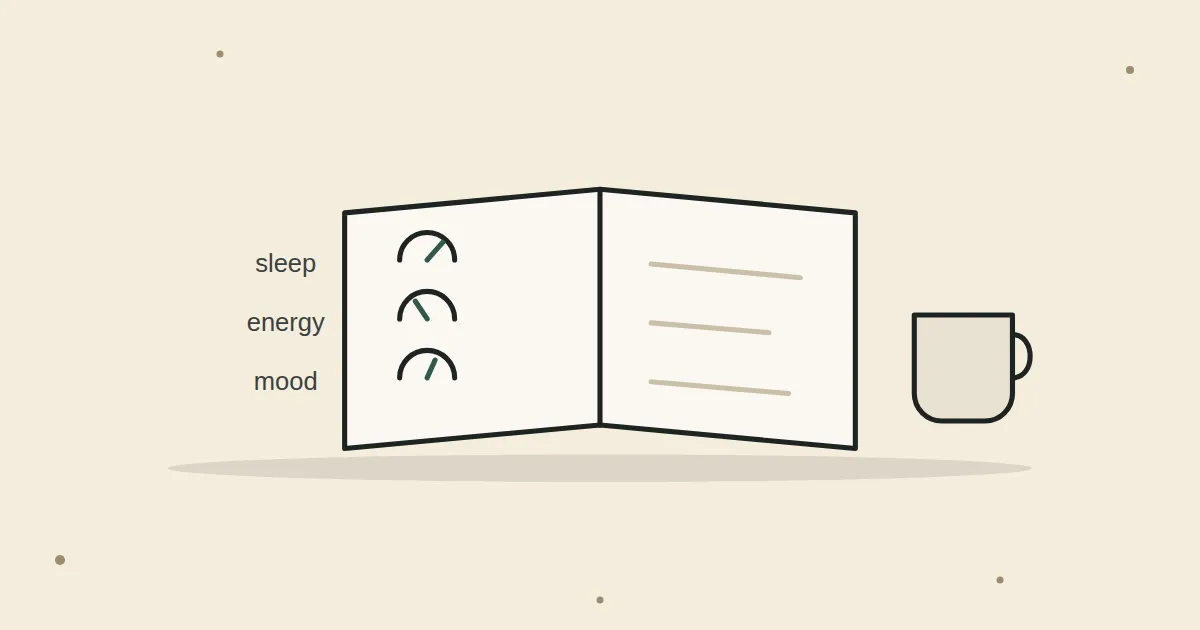
A self-care journal is a notebook where you check in on how you’re doing and track what helps and what drains you. A good entry takes two minutes: how you slept, your energy and mood, one thing that helped, one that didn’t and one small thing for tomorrow. Any notebook works.
Two-minute check-in
How are you doing, actually?
Your entry
Copy it into your journal. Nothing you type here is stored or sent anywhere.
Quick takeaways
- A self-care journal is for noticing: how you’re doing, what helps and what drains you.
- Two minutes a day is enough. The check-in above is a complete entry.
- You don’t need to buy a special journal. A plain notebook or notes app does the same job.
- The value shows up when you read back and spot patterns, like the same drained feeling every Sunday.
- It’s everyday self-reflection, not therapy. If things feel heavy for a while, talk to someone.
What is a self-care journal?
A self-care journal is a notebook for keeping track of your own wellbeing: how you’re sleeping, how much energy you have, how you feel and what seems to help. It’s less about writing beautifully and more about checking in regularly, so you can see what’s changing and look after yourself sooner.
Self-care is a bigger idea than bubble baths. The World Health Organization’s definition of self-care is “the ability of individuals, families and communities to promote health, prevent disease, maintain health and cope with illness and disability with or without the support of a health worker.” A journal is one of the simplest tools for the everyday end of that: noticing early, before tired becomes exhausted.
What goes in a self-care journal?
A self-care journal usually holds a short daily check-in (sleep, energy, mood), a note on what helped and what drained you, and one small intention for tomorrow. Some people add gratitude lists, notes on meals or movement, or a longer entry on harder days. Keep only what you’ll actually fill in.
A simple daily page looks like this:
- The date, so patterns show up later.
- Sleep, energy and mood, a word each is enough.
- What helped today, however small: lunch outside, a phone call, an early night.
- What drained you, without judging it.
- One small thing for tomorrow, something you can definitely do.
That’s the whole format. On a good day it takes two minutes. On a hard day you might write two pages, and that’s what the space is for.
How do you start a self-care journal?
Start a self-care journal by picking any notebook, choosing a regular time, and writing the five-line check-in above for one week. Don’t plan sections or buy supplies first. After a week, read it back and keep the parts that told you something.
If you’re new to journaling in general, the basics are in how to start journaling. The short version: tie it to something you already do every day, keep it short and carry on after a missed day.
A few things make a self-care journal easier to keep:
- Write at the same point every day. End of the day works well for a check-in, because there’s a day to check in on.
- Use words, not scores. “Tired but okay” tells you more later than a 6 out of 10.
- Write the drained list without fixing it. Noticing comes first. Solutions can wait.
Do you need to buy a self-care journal?
No. Guided self-care journals can be nice, and some people like the structure of printed questions, but a plain notebook does the same job. If you do buy one, choose it for the questions inside, not the cover, and make sure the pages suit how much you actually write.
Most of what you see when you search for a self-care journal is a shop, which can make it feel like a purchase is step one. It isn’t. The check-in on this page, written into whatever notebook you have, is a self-care journal.
How is a self-care journal different from a gratitude journal or a diary?
A self-care journal tracks how you’re doing and what helps, so you can look after yourself. A gratitude journal lists what you’re thankful for. A diary records what happened. Many people mix all three, and that’s fine; the labels matter less than writing regularly.
| Self-care journal | Gratitude journal | Diary | |
|---|---|---|---|
| Main question | How am I doing, and what helps? | What am I thankful for? | What happened? |
| Typical entry | Check-in, helped, drained, one small thing | Three to five things | A few paragraphs about the day |
| Best for | Spotting patterns in energy and mood | Noticing the good on ordinary days | Remembering |
If you’d like to add a gratitude note to your check-ins, there’s a long list of things to be grateful for to borrow from, including a section for hard days. And when you want a question to write about, the journal prompts are sorted by mood.
How often should you write in a self-care journal?
Daily check-ins work best, because patterns only show up with regular data, but two or three times a week is still useful. One small trial had people journal for 15 minutes, three days a week, for 12 weeks. Pick a rhythm you can keep in a busy week.
That trial, a preliminary randomized study by Smyth and colleagues, involved 70 adults with medical conditions and raised anxiety. The group that did online positive-affect journaling reported less mental distress than the comparison group over the first two months, and higher resilience after one month. It’s one small study in a specific group, so it points to a sensible dose rather than proving a rule.
What can a self-care journal not do?
A self-care journal can help you notice how you’re doing, but it can’t diagnose anything, replace treatment or fix a situation that’s too heavy to carry alone. If your entries keep getting darker, or the same worry fills every page for weeks, that’s a sign to talk to someone.
I’m a counselling student, not a therapist, and this is everyday self-reflection, not therapy. One of the most useful things a journal does is show you, in your own handwriting, when things have been hard for longer than you’d realized. That’s a good moment to tell a friend, your doctor or a professional. For a step-by-step routine for harder stretches, see how to journal for mental health.
Self-care journal questions people ask
What should I write in a self-care journal?
Start with a check-in: how you slept, your energy and mood in a word each, one thing that helped, one that drained you and one small thing for tomorrow. Add anything else, like gratitude or notes on meals and movement, only if you find yourself wanting it.
Is a self-care journal the same as therapy?
No. A self-care journal is a way to notice how you’re doing day to day. Therapy is a relationship with a trained professional. Journaling can sit alongside therapy, and some therapists suggest it, but it isn’t a replacement for support when you need it.
When is the best time to write a self-care journal?
The evening suits a daily check-in, because you’re looking back over the day. Some people prefer a morning version: how they slept, how they feel and one small thing they’ll do for themselves. Pick whichever time you’ll keep.
Mike Arnold
Mike is a first-year counselling student who has journaled on and off for most of his life. He writes the how-to guides and the occasional bit of philosophy. About our writers