On this page
- Quick takeaways
- What is the Bullet Journal method?
- How do you bullet journal, step by step?
- What is rapid logging?
- How do you set up a bullet journal index?
- What goes in the future log?
- How does the monthly log work?
- What is a daily log?
- What is migration, and why bother?
- Where do collections and habit trackers fit?
- Is bullet journaling worth it?
- Bullet journal questions people ask
Your bullet journal does not need a hand-lettered header. It needs a pen, a notebook with numbered pages and about ten minutes of setup. Everything you’ve seen on Pinterest is decoration layered on top of a method that fits on one side of paper.
To bullet journal, write short, symbol-coded lines instead of full sentences (rapid logging), keep an index at the front, and plan in three layers: a future log for the months ahead, a monthly log and daily logs. At the end of each month, move unfinished tasks forward or cross them out.
Try rapid logging
Write three things about today in the fewest words you can.
- Reply to Sam
- ○Dentist, 3pm
- –Slept badly, but the walk helped
Tap a task's dot to cycle it: • open → × done → > migrated. Nothing here is stored or sent.
Quick takeaways
- The Bullet Journal method was created by Ryder Carroll. The official version uses no art at all.
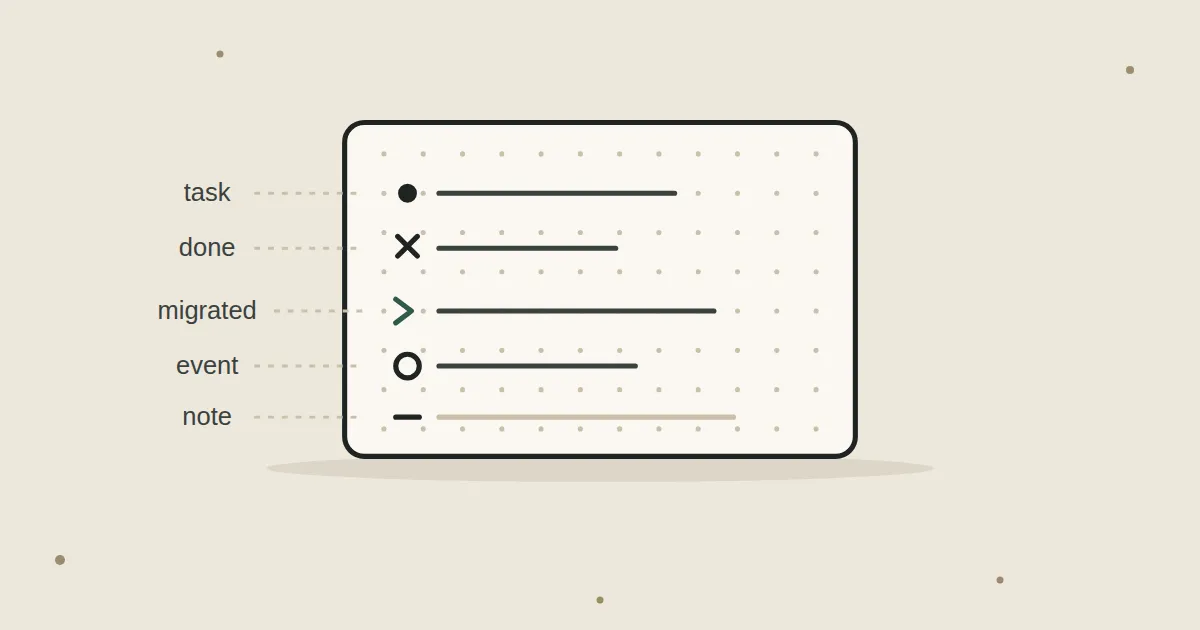
- Rapid logging is the core: a dot for a task, a circle for an event, a dash for a note.
- Four pieces do the organizing: the index, future log, monthly log and daily log.
- Migration is the secret weapon. Once a month, every open task gets moved or crossed out.
- A cheap notebook and one pen will do. Decoration is a hobby, not a requirement.
What is the Bullet Journal method?
The Bullet Journal method is a notebook system for tracking tasks, events and notes in short, symbol-coded lines. Its creator, Ryder Carroll, describes it as combining “mindfulness, productivity, and self-discovery.” It works in any notebook, and it needs no drawing, stickers or special pens.
You’ll find that description on the official Bullet Journal site. The method is deliberately plain: a notebook becomes your to-do list, calendar and diary at once, written in a quick shorthand so it stays useful on a busy day.
The ugly version works. The beautiful spreads online are people enjoying a craft on top of it, which is lovely, and entirely optional.
How do you bullet journal, step by step?
Number your pages, leave the first two blank for an index, draw a future log across the next spread, then start a monthly log and a daily log. Rapid log through each day. At the end of the month, migrate what’s unfinished into the next monthly log and start again.
- Number the pages if your notebook doesn’t do it for you.
- Index: leave the first couple of pages blank and title them “Index.”
- Future log: on the next spread, draw a six-month grid for dates and plans further ahead.
- Monthly log: on the next spread, the month’s calendar goes on the left and its tasks on the right.
- Daily log: write today’s date and rapid log as the day happens.
- Migrate: at the end of the month, review every open task and move it or cross it out.
Setup takes about as long as a cup of tea. After that, the daily log is where you spend nearly all your time.
What is rapid logging?
Rapid logging means writing short, bulleted lines instead of sentences: a dot (•) for a task, a circle (○) for an event and a dash (–) for a note. Completed tasks get an X, migrated tasks an arrow (>) and scheduled tasks a backwards arrow (<).
Bullet Journal calls rapid logging “the language in which the Bullet Journal method is written.” Their example turns “I bought cake at the local bakery today and went home” into “Bought cake and went home.” You can see it on their how to bullet journal page.
You can add signifiers in front of a bullet to give it extra meaning: an asterisk (*) for priority, an exclamation mark (!) for inspiration. That’s about all the symbols most people need. The fuller list of keys and symbols is on the rapid logging page.
To build a key of your own and print it as a card, see the bullet journal key guide.
How do you set up a bullet journal index?
Leave the first two pages of your notebook blank and title them “Index.” Each time you start something you’ll want to find again, like a monthly log, a list or a project, write its name and page number in the index. It turns a notebook into something you can search.
Most people skip the index, then spend ten minutes hunting for the page where they wrote the plumber’s number. It takes five seconds to keep up. You don’t need to index daily logs, just monthly logs and collections.
What goes in the future log?
The future log holds dates and plans beyond this month: birthdays, trips, deadlines. Draw two evenly spaced horizontal lines across a spread to make six boxes, one per month. When a new month starts, you copy that month’s items into its monthly log.
Bullet Journal’s own guide to making a future log describes it as a six-month calendar across two facing pages. You can make it cover twelve months with smaller boxes. My advice: six is plenty, because plans further out than that tend to change anyway.
How does the monthly log work?
The monthly log takes one spread per month. On the left page, list the dates down the margin and note events next to them. On the right page, list the tasks you want to get done that month. It’s the overview you check before planning each day.
The calendar side stays sparse on purpose: a word or two per date. The task side is where migrated tasks from last month land, alongside new ones.
What is a daily log?
A daily log is the page where you rapid log each day. Write the date as a heading, then add tasks, events and notes as they happen. Bullet Journal treats it as the smallest building block of the system. Don’t pre-draw a week of empty days, just start a new date when a new day starts.
That last point saves the most frustration. A pre-drawn week guarantees blank boxes on the busy days, and blank boxes feel like failure. A daily log that only exists once you write in it never looks empty.
What is migration, and why bother?
Migration is a monthly review of every open task. For each one, you either cross it out because it no longer matters, or move it forward with an arrow (>) into the new month. Bullet Journal’s rule of thumb is that anything not worth rewriting probably isn’t that important.
The official migration guide, written by Ryder Carroll, puts it this way: “If an entry isn’t worth the effort to rewrite, then it’s probably not that important.” The small effort of copying a task by hand is the point. It forces a decision you’d otherwise keep postponing.
This is also the step most people drop, and the reason their bullet journal turns into a graveyard of half-finished lists. Ten minutes on the last day of the month keeps the whole thing honest.
Where do collections and habit trackers fit?
Collections are themed pages for related things, like a reading list, a trip plan or a habit tracker. Start one on the next blank page, give it a title and add it to the index. Habit trackers are the most popular collection: habits down the side and days across the top.
If you’d rather not draw a grid by hand every month, the printable habit tracker builder makes one for any month. Print it, trim it and stick it in.
For six ways to lay out a habit tracker in your notebook, see the bullet journal habit tracker guide.
Is bullet journaling worth it?
Yes, if you use the plain version. Bullet journaling works because it’s quick: short lines, one notebook and a monthly review. It stops working when setup becomes the hobby and planning the month takes a whole Sunday. Keep the method and skip the decoration unless you enjoy it.
My verdict: try the ugly version for one month. Number the pages, draw the index and logs in pen, and rapid log every day. If you’re still using it at the end of the month, you’ve found your system. If you’re not, you’ve lost a cheap notebook and learned something.
A bullet journal is one of several ways to plan. The planning and habits hub compares it with printed planners, habit trackers and digital journals, with a picker to match you to one.
Bullet journal questions people ask
Do you need a special notebook for bullet journaling?
No. Any notebook works. Dotted pages make drawing grids easier and numbered pages save a job, but a lined notebook from the grocery store will do everything the method needs.
Is bullet journaling a waste of time?
It can be, if you spend more time decorating than planning. The method itself takes a few minutes a day plus ten minutes of migration at the end of the month. If that time helps you remember and decide, it isn’t wasted.
What are common bullet journaling mistakes?
Over-decorating, starting too many collections at once, pre-drawing whole weeks, and never migrating. The last one matters most: without migration, old tasks pile up and the journal stops being trustworthy.
What do you put in a bullet journal?
Tasks, events and notes in the daily log, plus whatever collections you actually use: a habit tracker, a reading list, meal plans, project notes. Start with the logs and add collections only when you find yourself wanting one.
Otis Fenn
Otis covers planning methods, notebooks, pens and apps, so you don't buy three of each. Otis is a pen name Mike writes under. About our writers