On this page
Most of us notice we’ve run out of something only when it’s gone: sleep, patience, time with friends. A self care wheel is a way of checking the gauges before the warning light comes on. You look at each area of your life, ask how it’s going, and see at a glance where the gaps are.
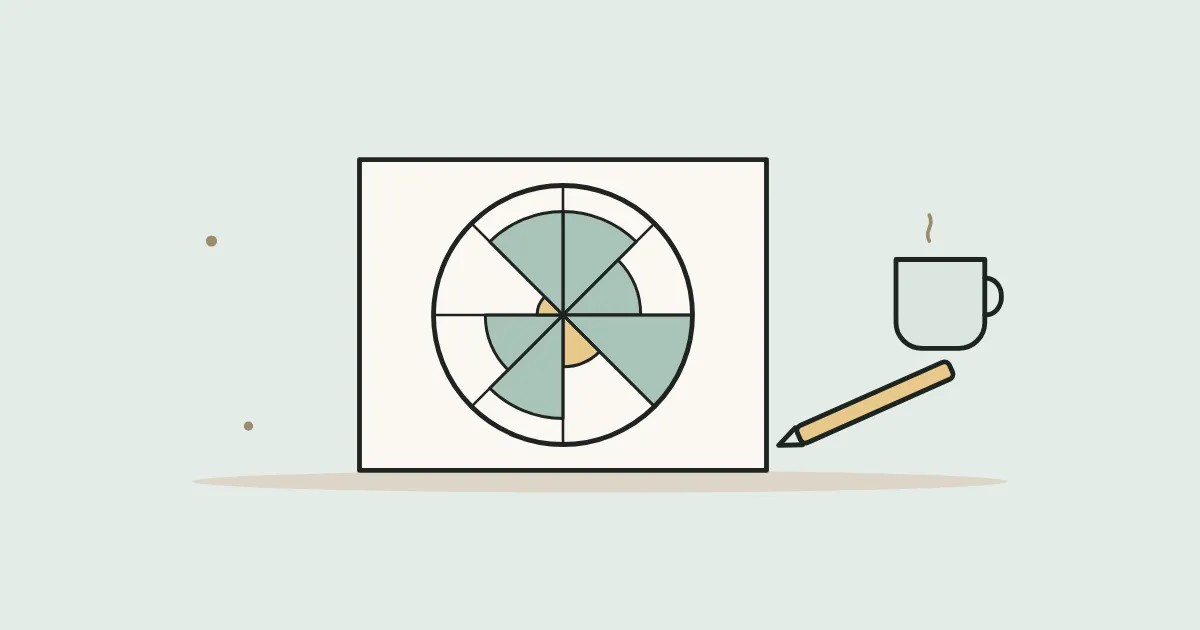
A self care wheel is a circle divided into areas of life, like physical, emotional, social and work, that helps you see which areas you’re looking after and which you’re neglecting. To use one, rate each area, notice the lowest one or two, and choose one small action for each. The best-known version is the Self-Care Wheel© by Olga Phoenix.
Self-care check-in
Rate each area from 0 to 5. The wheel shows where to start.
Start with
A check-in, not a test. There’s no right score, and nothing you enter is stored or sent.
Quick takeaways
- A self care wheel splits your life into areas so you can check each one, rather than asking “am I okay?” all at once.
- The original Self-Care Wheel© was created by Olga Phoenix in 2013. It’s free for personal use from her website.
- The check-in above is our own simpler version: eight areas, a score from 0 to 5, and ideas for your two lowest.
- Pick one or two areas to work on, not all eight.
- Do a check-in once a week or once a month, and compare over time.
What is a self care wheel?
A self care wheel is a visual tool that divides self-care into areas of life, shown as slices of a circle. Each slice lists ways to look after that part of yourself. It helps you see self-care as more than rest, and spot which areas you’ve been ignoring.
The best-known version is the Self-Care Wheel© created by Olga Phoenix in 2013. It divides self-care into six dimensions: psychological, emotional, physical, personal, professional and spiritual, with practical ideas in each slice. Her website offers it free to download for personal use, and she licenses it for professional and organizational use. It’s copyrighted and not to be altered or recreated without permission, so if you want the original, download it from her site.
The check-in on this page is our own tool. It’s built on the same basic idea, a wheel of life areas, but with eight everyday areas and a scoring step, so you can see your balance at a glance and print it.
Why use a self care wheel?
Because self-care is easy to think of too narrowly. A wheel reminds you that looking after yourself includes sleep and movement, but also friendships, boundaries at work, fun and a sense of meaning. Seeing all the areas together makes the gaps obvious.
The World Health Organization’s definition of self-care is broad: “the ability of individuals, families and communities to promote health, prevent disease, maintain health and cope with illness and disability with or without the support of a health worker.” A wheel is a small, everyday way into that: a regular look at the things that keep you going.
It’s also a way to be fair to yourself. On a bad week it’s easy to feel like everything is falling apart. A wheel can show that two areas are struggling and the rest are okay, which is a much more manageable problem.
How do you use a self care wheel?
Rate each area of your life, look at the one or two lowest scores, and choose one small, specific action for each. Write it down, do it this week, and check in again in a week or a month to see what’s changed.
- Rate each area. From 0 (running on empty) to 5 (well looked after). Go with your first answer.
- Look at the shape. A wheel with one or two short slices is normal. Nobody scores five everywhere.
- Pick the lowest one or two. Not all of them. Two small changes are more likely to happen than eight.
- Choose one small action. Specific and doable this week: “walk after lunch on Tuesday and Thursday,” not “exercise more.”
- Write it down. The check-in has a box for it, and it prints on the sheet.
- Check in again. Same day each week or month. Compare the shapes.
What areas should a self care wheel include?
Self care wheels generally cover the body, the mind and emotions, relationships, work and a sense of meaning. Our check-in uses eight everyday areas: sleep and rest, movement, food and water, connection, fun and play, calm and mind, work and boundaries, and meaning.
| Area | What it covers | Ask yourself |
|---|---|---|
| Sleep and rest | Sleep, breaks, doing nothing | Am I rested most days? |
| Movement | Walking, exercise, stretching | Does my body get to move? |
| Food and water | Regular meals, water, cooking | Am I eating in a way that keeps me going? |
| Connection | Friends, family, community | Have I had a real conversation this week? |
| Fun and play | Hobbies, laughter, doing things for their own sake | When did I last do something just for fun? |
| Calm and mind | Quiet, reflection, time outside | Do I have any space to think? |
| Work and boundaries | Workload, saying no, stopping | Does work stay in its lane? |
| Meaning | Values, purpose, helping others | Am I spending time on what I care about? |
If an area doesn’t fit your life, change it. The point is to look at everything that keeps you well, in whatever words make sense to you.
How do you use a self care wheel in a journal?
Draw a simple wheel on a page once a month, shade each slice to its score, and write two or three lines underneath: what changed, which area to focus on, and one small action. Over a few months, the pages show your patterns.
- Monthly wheel. Draw a circle, divide it into eight, shade each slice. It takes five minutes.
- Weekly one-liner. On other weeks, just write your lowest area and one thing you’ll do.
- Notice patterns. Does connection always drop in busy months? Does sleep slip when work does?
- Write about the lowest slice. Five minutes on why it’s low and what would help.
Fold the printed check-in in half to tuck it into a notebook. For more ways to look after yourself on paper, the self-care and wellbeing hub has a guide to keeping a self care journal.
When is a self care wheel not enough?
A self care wheel is a check-in, not a diagnosis. If most areas score low for weeks, or you feel unable to cope, that’s a sign to talk to a doctor or someone you trust rather than trying harder at self-care on your own.
Self-care can help you stay steady, but it isn’t a substitute for support when things are hard. There’s a list of places to find someone to talk to, in the US and the UK, on our support page.
Self care wheel questions
Who created the self care wheel?
The best-known Self-Care Wheel© was created by Olga Phoenix in 2013. It’s free to download for personal use from her website, and licensed for professional and organizational use.
What are the six areas of the self care wheel?
Olga Phoenix’s Self-Care Wheel© uses six dimensions: psychological, emotional, physical, personal, professional and spiritual. Other versions, including the check-in on this page, use different areas.
How often should I do a self care wheel?
Once a week if you’re going through a busy or hard stretch, once a month otherwise. The value is in comparing over time.
Can I print the self care check-in?
Yes. Fill it in above and choose “Print my wheel,” or choose “Print a blank wheel” to shade by hand.
Is a self care wheel the same as a wheel of life?
They’re similar. A wheel of life usually rates areas like career, money and relationships to help with goal setting, while a self care wheel focuses on how well you’re looking after yourself in each area.
Mike Arnold
Mike is a first-year counselling student who has journaled on and off for most of his life. He writes the how-to guides and the occasional bit of philosophy. About our writers