On this page
- Quick takeaways
- What is interstitial journaling?
- Why does journaling between tasks help?
- How do you do interstitial journaling, step by step?
- What does an interstitial journal entry look like?
- Interstitial journaling templates
- How is interstitial journaling different from a to-do list or a daily log?
- Who is interstitial journaling good for?
- Interstitial journaling questions
Most journaling happens at the start or end of the day. Interstitial journaling happens in the gaps: the minute after you finish one thing and before you start the next. You write the time, a line about what you just did and a line about what you’re about to do.
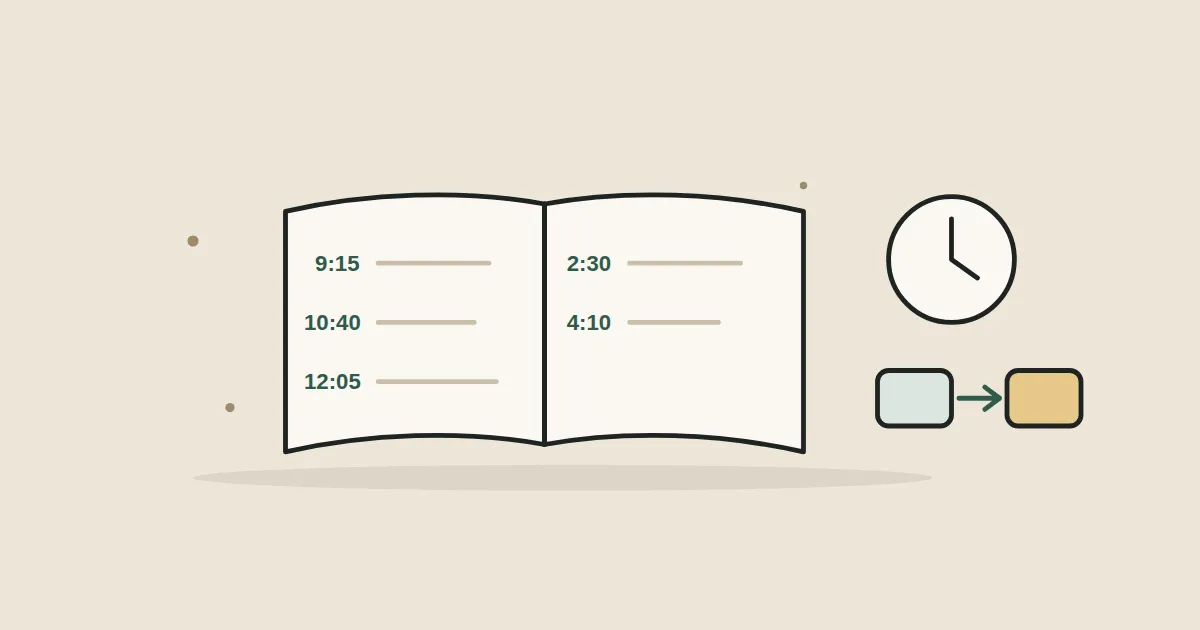
Interstitial journaling is writing a short, timestamped note every time you switch tasks. Each entry answers two questions: what did I just finish, and what’s still on my mind about it? And what am I starting next, and what’s the first step? It takes about a minute and turns your day into a running log.
Try an interstitial journal entry
--:-- Write this between two tasks.
Entries stay in this tab only. Nothing is stored or sent, so copy or download your log before you close the page.
Quick takeaways
- Write every time you switch tasks, not at a fixed time of day.
- Each entry: the time, what you finished (and what’s nagging you about it), and the first step of what’s next.
- Keep entries to two or three lines. It should take about a minute.
- It helps clear the last task out of your head before you start the next one.
- By evening, the log shows where your time went.
What is interstitial journaling?
Interstitial journaling is a journaling method where you write a few lines in the gaps between tasks, starting each entry with the time. The name comes from “interstitial,” meaning in the spaces between. Tony Stubblebine described the method in a 2017 article as a replacement for a to-do list.
In his Better Humans article, Stubblebine’s instruction is: “During your day, journal every time you transition from one work project to another.” Each entry has a timestamp, a reflection on what you just finished and a plan for how you’ll approach the next task.
It works on paper, in a notes app or in a document you keep open all day. The format matters less than doing it at every switch.
Why does journaling between tasks help?
Switching tasks leaves part of your attention on the task you just left. A short entry gives that leftover thought somewhere to go, then points you at the first step of the next job, so you start it with a clearer head.
Researcher Sophie Leroy calls this leftover thinking “attention residue”: thoughts about the previous task that persist after you’ve moved on. In her 2009 experiments, people who switched away from an unfinished task performed worse on the next one.
An interstitial entry deals with both halves of the switch. Writing down what’s unfinished or bothering you about the last task gets it out of your head, and writing the first step of the next task gives you a way in.
How do you do interstitial journaling, step by step?
Keep a journal or note open all day. Each time you finish or pause a task, write the time, one or two lines about what you just did and what’s still on your mind, then one or two lines about what you’re starting next and its first step. Then start.
- Keep your journal within reach. A notebook on the desk, or a note pinned on your phone or computer.
- Write the time. Every entry starts with it.
- Close the last task. What did you finish? What’s left over, still bugging you, or needs doing later?
- Open the next task. What are you starting? What’s the very first action?
- Add anything else on your mind. A worry, an idea, a thing to buy. Get it on the page so it stops nagging.
- Start the next task. The entry is done. Don’t reread it.
- Look back when you finish work. Skim the times. Where did the day go? What kept coming up?
What does an interstitial journal entry look like?
A typical entry is two to four lines: the time, what you finished, what’s nagging you and what you’re starting next. It can be messy and abbreviated. Here are three made-up examples from one morning.
9:12 Finished inbox. Still need to reply to Dana about Friday, parked it for after lunch. Next: budget report. First step: open last month’s file and copy the layout.
10:48 Report half done, stuck on the travel numbers. Annoyed, need Sam’s receipts. Messaged him. Next: 30 min on the website copy while I wait. First step: reread yesterday’s draft.
11:35 Website copy: rewrote the intro twice, fine for now. Hungry, getting scattered. Next: lunch, away from the desk.
Interstitial journaling templates
Use a template until the questions become a habit. Pick the one that fits your day, and keep it short enough to fill in under a minute.
- Basic: Time. Just finished… Still on my mind… Next up… First step…
- Focus: Time. What did I get done? What pulled my attention? What’s the one thing for the next hour?
- Energy: Time. How’s my energy, 1 to 5? What do I need before the next task: food, water, a walk?
- Worry dump: Time. What’s nagging me right now? Is it something to do, decide or drop?
- Deep work: Time. What will “done” look like for this block? What will I ignore until it’s over?
- End of day: Time. What got done? What moves to tomorrow? What’s tomorrow’s first step?
How is interstitial journaling different from a to-do list or a daily log?
A to-do list is a plan of what you’ll do. A daily log records what happened. An interstitial journal does both in small pieces during the day, and adds how you felt about each switch.
| To-do list | Daily log | Interstitial journal | |
|---|---|---|---|
| When you write | Before the day | During or after the day | At every task switch |
| What it records | Plans | Tasks and events | Time, what’s done, what’s next, what’s on your mind |
| Best for | Remembering tasks | Keeping a record | Focus and cleaner switching |
It works alongside a bullet journal too: use the daily log for tasks and add short interstitial notes between them. For other journaling styles and what each is good for, see the types of journaling. For other ways to plan your day, see the planning and habits hub.
Who is interstitial journaling good for?
It suits people whose days are made of lots of switches: desk workers, freelancers, students, parents working from home, and anyone who ends the day wondering where it went. It’s less useful on days with one long task.
- Freelancers and remote workers. It shows where the hours went, which helps with time tracking and billing.
- Students. It makes study sessions easier to start and notes where you stopped.
- Anyone who procrastinates. Writing the first step of the next task lowers the bar to starting.
- Busy heads. A running log is a place to put stray thoughts during the day, like a mini brain dump at every switch.
Interstitial journaling questions
How often should you write in an interstitial journal?
Every time you switch tasks. That means a few entries on a day of long tasks, and more on a day full of meetings and small jobs.
Should interstitial journaling be on paper or digital?
Either. Paper keeps you away from screens between tasks. A digital note is easier if you work at a computer all day. Pick whatever you can open in under five seconds.
How long should each entry be?
Two to four lines, or about a minute. If you’re writing longer, save it for a separate journaling session.
Can you use interstitial journaling outside work?
Yes. Use it on weekends or days off to notice how you spend your time, or when you’re switching between chores and rest.
Who invented interstitial journaling?
Tony Stubblebine described it in a 2017 article for Better Humans as an alternative to to-do lists.
Otis Fenn
Otis covers planning methods, notebooks, pens and apps, so you don't buy three of each. Otis is a pen name Mike writes under. About our writers