On this page
A weekly planner page should fit your week, not the other way round. If you live by appointments, you want tall day columns. If your week is a list of tasks, you want rows with room for a to-do list beside them. If you just want the big picture, eight boxes will do.
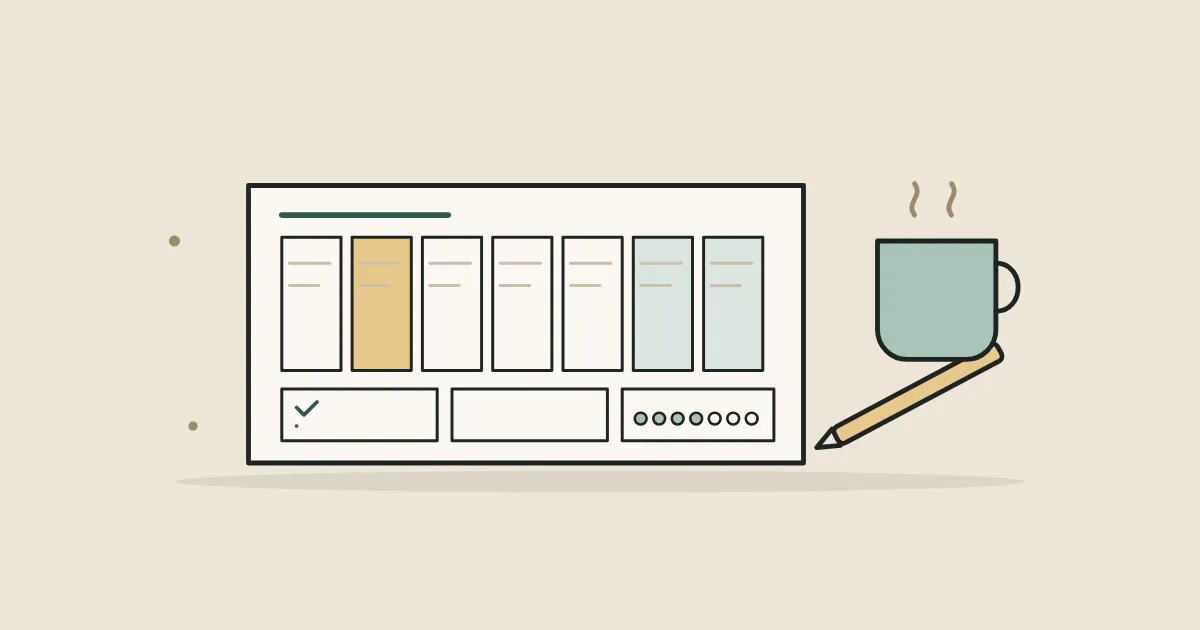
This free printable weekly planner builds itself. Pick a layout (days in columns, days in rows or eight boxes), tick the boxes you want (top 3 priorities, to-do list, habit row, notes, meals), choose the week or leave it undated, and print one page on US Letter or A4. Fill it in once a week, then check it for two minutes each morning.
Build your weekly planner
Choose a layout and the boxes you’ll use. Print a page a week.
Quick takeaways
- Choose the layout by how your week works: appointments suit columns, task lists suit rows, and a light week suits eight boxes.
- Put fixed commitments in first, then your three priorities, then everything else.
- Leave room. In one study, students’ thesis estimates came in about three weeks short, so a full page on Sunday can be an overfull week by Wednesday.
- Print it undated if you want a stack you can use any week.
- Keep it where you’ll see it every morning, not in a drawer.
What should a weekly planner include?
A weekly planner needs a space for each day, a short list of priorities and a to-do list for tasks that don’t belong to a specific day. Add a habit row if you’re building habits and a meal plan if dinner decisions eat your evenings. Leave out anything you won’t fill in every week.
| Box | What it’s for | Include it if… |
|---|---|---|
| Days | Appointments, deadlines and tasks with a date | Always |
| Top 3 priorities | The three things that would make the week a good one | Always |
| To-do list | Tasks without a date | You have more than a handful of loose tasks |
| Habit row | A tick for each day you did a habit | You’re building two or three habits |
| Meals | Dinner for each night | You shop once a week |
| Notes | Anything else | You like a catch-all space |
The builder only prints the boxes you tick, and the day boxes grow to fill the space you save.
Which weekly planner layout should you choose?
Choose days in columns if your week is full of appointments and you like to see it at a glance. Choose days in rows if your week is mostly tasks and you want a big to-do list beside it. Choose eight boxes for a lighter week or a simple overview to pin on the fridge.
| Layout | Prints | Best for | Room per day |
|---|---|---|---|
| Days in columns | Landscape | Appointments, shift work, busy households | Tall and narrow |
| Days in rows | Portrait | Task-heavy weeks, students, freelancers | Short and wide |
| Eight boxes | Portrait | Light weeks, family overviews, the fridge | Square |
How do you fill in a printable weekly planner?
Start with what can’t move: appointments, deadlines, pickups. Then choose your three priorities and give each one a day. Add the remaining tasks to the to-do list, not the days. Check the page for two minutes each morning and move anything that didn’t happen.
- Fixed commitments first. Work shifts, appointments, school runs. These shape the space you actually have.
- Three priorities. Write them in the priorities box, then put each one on a specific day.
- Everything else goes on the to-do list. Only move a task onto a day when you’ve decided to do it that day.
- Leave one evening blank. It’s where the overflow goes when something takes longer than planned.
- Morning check. Two minutes: today’s appointments, today’s priority and the first step.
- Sunday review. Before printing next week’s page, circle what didn’t happen and decide whether it moves forward or gets dropped.
Writing down when and where you’ll do something makes it more likely to happen. A meta-analysis by Peter Gollwitzer and Paschal Sheeran of 94 tests found that specific if-then plans had a medium-to-large effect on reaching goals (d = 0.65). Giving a priority a day and a time on the page is a simple version of the same idea.
How much should you plan in a week?
Plan less than feels right. In a classic study of students writing their theses, the average prediction was 33.9 days and the average actual time was 55.5 days. Fill your page to about two thirds, and use the blank space for what runs over.
The study, by Roger Buehler, Dale Griffin and Michael Ross, gave the effect a name: the planning fallacy. Fewer than a third of the students (29.7%) finished by the date they’d called their most realistic guess.
A weekly planner can’t fix that on its own, but it can make it visible. If the same task gets moved three days in a row, it’s either bigger than you thought or less important than you thought. Both are worth knowing.
Where should you keep a printed weekly planner?
Keep it somewhere you’ll see it at the start of each day: on the fridge, pinned by your desk, clipped inside your journal or folded into your bag. A planner you have to go looking for is a planner you’ll forget by Tuesday.
- Fridge or pinboard for a household week that everyone needs to see.
- Clipboard on the desk for work weeks.
- Folded into your journal if you already keep a notebook.
- A ring binder if you want to keep past weeks. Punch the left edge before you fill it in.
If you’re tracking habits for a whole month rather than a week, the printable habit tracker makes a monthly grid you can print the same way. For other ways to plan, including bullet journals and digital options, see the planning and habits hub.
Weekly planner questions
Is this weekly planner really free?
Yes. There’s no sign-up and no email needed. Build the page, print it, and print as many as you like.
Can I print an undated weekly planner?
Yes. Tick “Leave the dates blank” and the page prints with a blank line for the week and no day numbers, so you can print a stack and use one each week.
Should my week start on Monday or Sunday?
Whichever matches how you think about the week. Monday suits a work week with a weekend at the end. Sunday suits people who plan on Sunday and like to see the whole weekend together. The builder does both.
Can I print it on A4?
Yes. Choose A4 under Paper. Days in columns prints landscape; the other two layouts print portrait.
What’s the difference between a weekly and a daily planner?
A weekly planner shows seven days on one page, so you can see how the week balances out. A daily planner gives each day its own page, with room for an hour-by-hour schedule. If your days are packed with meetings, you may want both.
Otis Fenn
Otis covers planning methods, notebooks, pens and apps, so you don't buy three of each. Otis is a pen name Mike writes under. About our writers