On this page
A mood tracker is the quietest page in a bullet journal. One color a day, a few seconds each evening. It doesn’t look like much until the end of the month, when the colors start to line up with things: bad sleep, busy Mondays, the week a friend visited.
A bullet journal mood tracker is a page where you record your mood once a day, usually by coloring a square in a key of about five moods. To make one, choose your moods and colors, draw a layout (a month calendar or a year-in-pixels grid are the simplest), fill it in at the same time each evening and look back at the end of the month for patterns.
Make your mood tracker
Name your five moods, choose a layout, try it out, print it blank.
Pick a mood, then tap days to try it. The printout is blank, with your key. Nothing you do here is stored or sent.
Quick takeaways
- Five moods is enough. Name them with words, not just colors, so you know what green meant in three months.
- Fill it in at the same time each day. Evening is a good default because it covers the whole day.
- A month calendar is the easiest place to start. Year in pixels is the long view.
- The value is in the review: look at the whole month and ask what the good and bad days have in common.
- Naming a feeling can help on its own. A mood tracker is a small, daily way of doing it.
What is a mood tracker in a bullet journal?
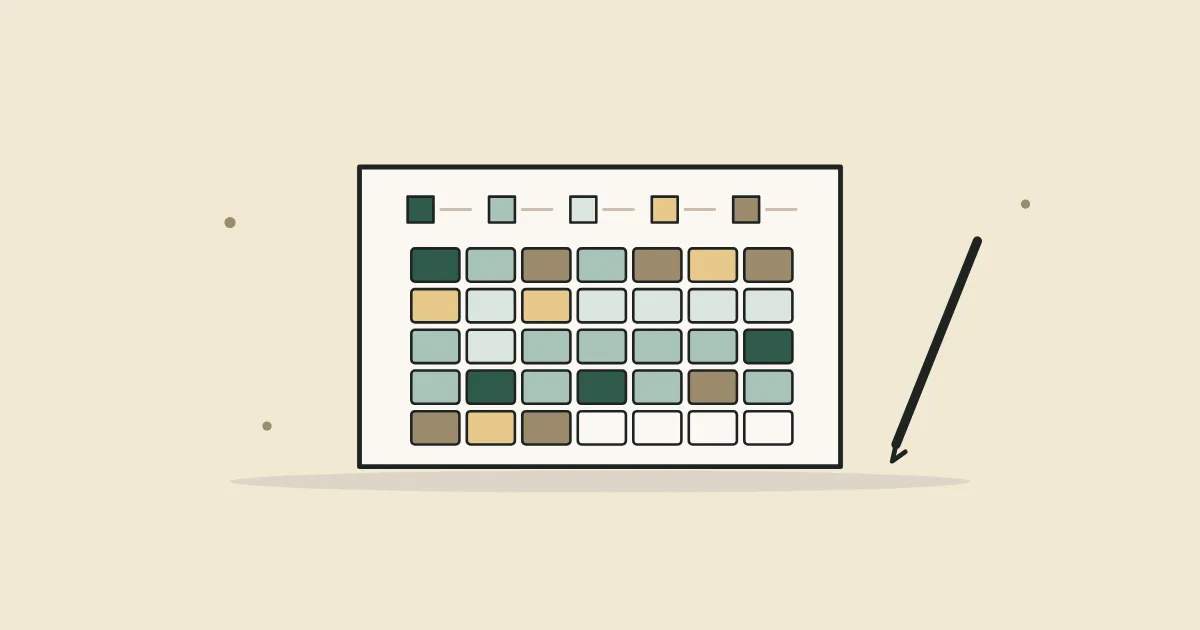
A mood tracker is a page, usually one per month, where you mark how you felt each day using a small key of moods and colors. It turns vague impressions (“October was hard”) into something you can see: which days were hard, and what else was going on.
It sits alongside the other trackers in a bullet journal, often next to a bullet journal habit tracker so you can compare the two. Habits are things you do; mood is how the day felt. Put side by side, they start to explain each other.
How do you make a mood tracker?
Pick five moods and give each a color, draw a key at the top of the page, draw a square for each day of the month, and color one square each evening. At the end of the month, write two or three lines about what you notice.
- Choose your moods. Five is a good number: two good, one neutral, two hard. The maker above starts with Great, Good, Okay, Low and Rough; rename them to words that sound like you.
- Choose your colors. Pick colors you own in pens or pencils, and make the scale easy to read, light to dark or cool to warm.
- Draw the key first. It stops you from inventing a sixth color halfway through the month.
- Draw the layout. A calendar grid is quickest. The next section has eight options.
- Color one square each evening. If the day was mixed, split the square diagonally.
- Review at the end of the month. Write a few lines under the tracker: what the good days had in common, what the hard days had in common.
What are some mood tracker layout ideas?
The easiest layouts are a month calendar and a year in pixels. For more detail, try color plus one word, a mood line graph or a mood grid with sleep and energy. For something more decorative, draw a shape (a jar, a leaf, a bookshelf) and color one section per day.
- Month calendar. A normal calendar grid with one square per day. Quick to draw and easy to read.
- Year in pixels. Twelve columns for the months, 31 rows for the days. One small square each day, all year on one page.
- Color plus one word. A list of dates with a colored square and one word beside each: “tired”, “proud”, “restless.”
- Mood line graph. Days along the bottom, your five moods up the side. Draw a dot each day and join them.
- Mood, sleep and energy. Three rows under each date: mood color, hours slept and energy out of five. Patterns jump out.
- Weekly mood bar. A strip of seven squares in each weekly spread, for people who don’t use monthly pages.
- Shape to fill. Draw something with 28 to 31 sections, like a jar of marbles or a shelf of books, and color one a day.
- Morning and evening. Split each square diagonally: top half for how you woke up, bottom half for how the day ended.
The maker above draws the first three, and prints them blank with your own key.
How many moods should a mood tracker have?
Five moods is a practical number: enough to show the difference between an okay day and a good one, few enough to choose from in a second. Use words for each mood in the key, and consider adding one specific word a day, because naming a feeling precisely is useful on its own.
There’s some evidence for the words. In a brain-imaging study at UCLA, Matthew Lieberman and colleagues found that when 30 participants labeled the emotion in a picture, activity in the amygdala, a region involved in emotional reactions, was lower than when they did other tasks with the same picture. The researchers called it affect labeling. A one-word note beside your color is a small daily version of it.
If you want more words to choose from, the prompts for journaling by mood are sorted by feeling.
What can a mood tracker show you?
A month of colors can show you which days of the week are hardest, how your mood follows sleep, exercise or time with people, and whether a rough patch is a few days or a few weeks. It works best when you add one or two other things to compare against, like hours of sleep.
At the end of each month, try these three questions:
- Which days were best, and what did they have in common? Look for people, places, sleep and movement.
- Is there a weekday pattern? A run of Sunday evenings in the same color is worth noticing.
- What changed mid-month? If the colors shift, what else shifted at the same time?
Keep the answers short. Two or three lines under the tracker is plenty, and next month you’ll have something to compare them with.
When is a mood tracker not enough?
A mood tracker is a record, not a treatment. If most of your squares are in your two hardest colors for a couple of weeks, or the tracker itself makes you anxious, talk to a doctor or someone you trust. Your tracker can help that conversation, because it shows what the weeks were like.
A journal can still help alongside other support. The guide to journaling for mental health walks through a gentle routine, step by step.
For other trackers and ways to plan, see the planning and habits hub.
Mood tracker questions
What colors should I use for a mood tracker?
Any five you can tell apart at a glance and have pens for. A scale is easiest to read: dark green to pale green to yellow, or cool colors for low moods and warm for good ones.
When should I fill in my mood tracker?
At the same time each day. Evening is a good default because it covers the whole day. If mornings and evenings feel very different, split the square.
What if my mood changes a lot in one day?
Split the square diagonally, or pick the color that covered most of the day and add a word beside it. The tracker is for patterns across weeks, not a precise record of every hour.
What is a year in pixels?
A mood tracker covering a whole year on one page: twelve columns for the months and 31 rows for the days, with one small square colored each day. By December it shows the whole year’s shape.
Should I track mood on paper or in an app?
Either works. Paper makes you pause for a moment, which is part of the point. An app is easier to keep with you. Choose the one you’ll actually open every day.
Otis Fenn
Otis covers planning methods, notebooks, pens and apps, so you don't buy three of each. Otis is a pen name Mike writes under. About our writers